
Not Too Much, Not Too Little: Embryos Need Just the Right Tension to Take Shape
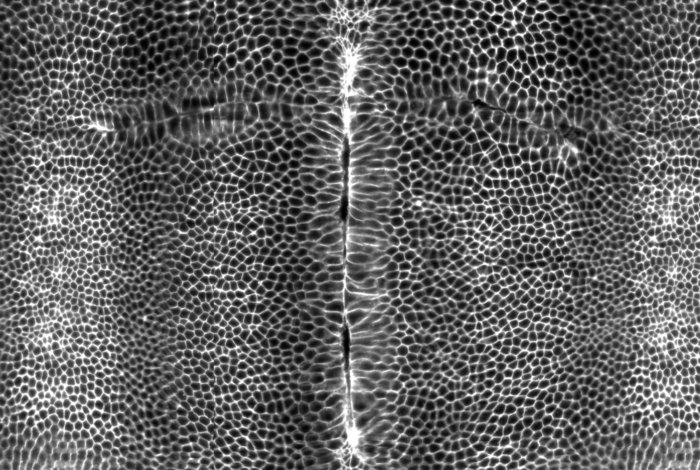
At the very beginning of life, an embryo undergoes a spectacular transformation. A single layer of cells folds, bends and reorganizes, moving inside the embryo the cells that will later form muscles and many internal organs. This crucial stage, known as gastrulation, lays the foundations of the future body. Although the chemical signals that initiate it are relatively well understood, one question has remained: how do different parts of the embryo coordinate their physical forces to fold correctly?
Abdul Basith Tanari and colleagues from the Institute of Biology Valrose (Université Côte d’Azur, CNRS, Inserm) and the Interdisciplinary Physics Laboratory (Université Grenoble Alpes, CNRS) investigated this process in fruit fly embryos. The fruit fly is a valuable model for observing cell movements in real time and uncovering fundamental principles of animal development.
The researchers focused on two developing tissues: the mesoderm, which must move inside the embryo, and the ectoderm, which surrounds it and remains on the surface. Until now, the mesoderm was mainly regarded as the driving force behind this movement, while the ectoderm was thought to play a more passive role. The new study shows that this picture is incomplete. The ectoderm provides an essential mechanical resistance whose strength must be adjusted with remarkable precision.
To reach this conclusion, the team combined several advanced approaches. They mapped mechanical tension across the embryo, observed the entire embryo in three dimensions over time and used light to modify forces within highly specific regions. This allowed them to increase or decrease tension in selected areas of the ectoderm at the exact moment when the mesoderm began moving inward.
The result was both clear and unexpected. When the tension exerted on both sides of the mesoderm became too strong, internalization failed. Yet it also failed when the tension became too weak. Successful development therefore does not simply require cells to generate as much force as possible. Instead, it depends on a delicate balance between tissues—much like a coordinated movement in which force, position and timing must all be precisely controlled. Surprisingly, insufficient resistance caused the mesoderm to contract twice as quickly, disrupting the carefully ordered sequence of cell movements.
These findings reveal that embryonic tissues do not build themselves independently. They transmit forces to one another and mutually control their movements across the whole embryo. The study opens new avenues for understanding how genes regulate the mechanical properties of tissues in both space and time. More broadly, the principles uncovered here could help explain other processes in which tissues fold to form organs—and shed light on why these transformations sometimes fail during development.